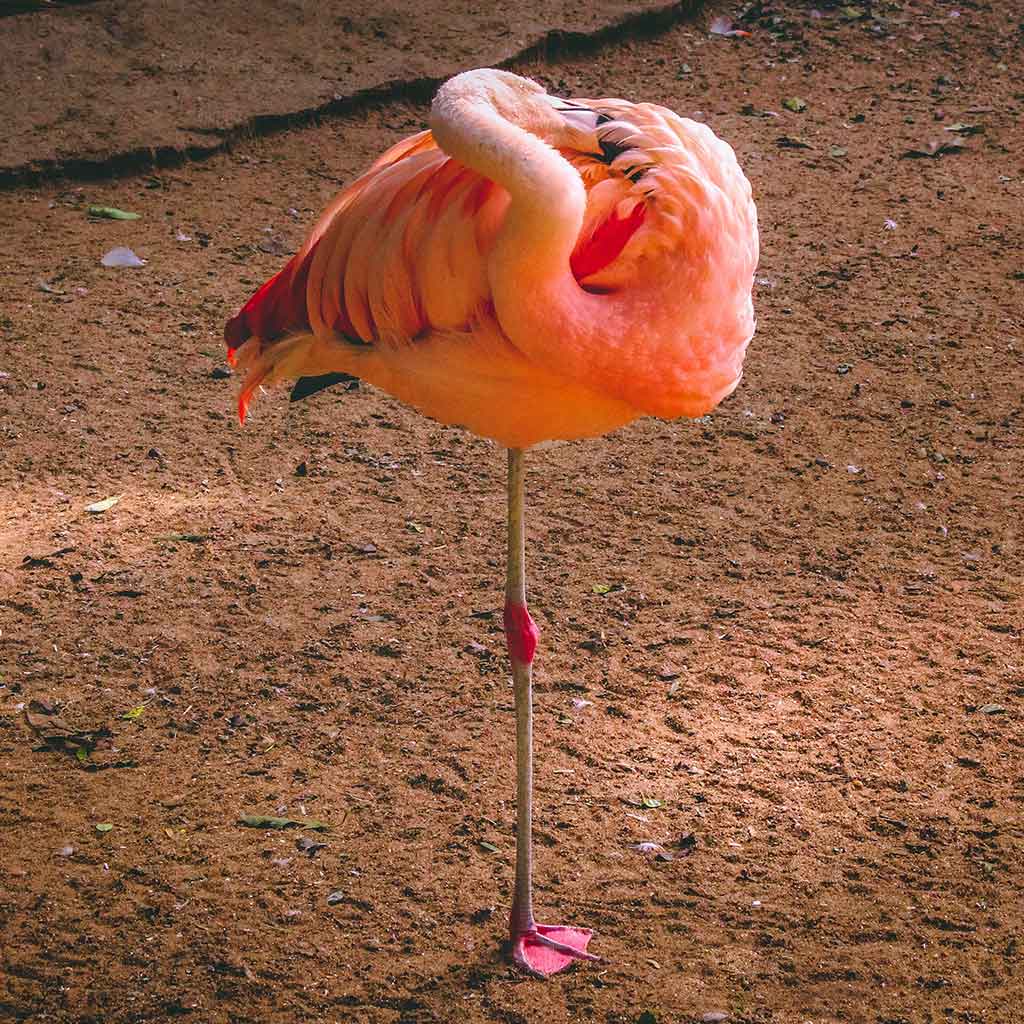
Why Do Flamingos Stand on One Leg?
Flamingos are beautiful, tall, slim, and elegant pink birds, famous for their pale pink feathers and habit of standing on one leg. They can maintain this posture for a long time. Plenty of birds stand on one leg, often while resting, but flamingos take the behavior to an extreme: they even do it while sleeping.
Why do flamingos stand on one leg? Their anatomy allows them to maintain a stable one-legged stance with little muscular effort. Tucking one leg beneath the body may also reduce heat loss while they wade, although flamingos use the posture in warm conditions too. More than one factor may be involved.
The Science Behind Flamingos
Flamingos are an ancient group of birds, dating back at least 50 million years. Today there are only five or six species. Flamingos are found throughout the world, wherever there are shallow salt pans or lagoons. They live in remote locations and extreme environments, and they move around a lot. The birds may seem to enjoy more the tropics, but they also live in the Andes, 15,000 feet above sea level, where they rest on lakes that freeze around them overnight.
Most of us, when we stand on one leg, we find it very difficult. Also, a tree pose yoga posture with closed eyes feels almost impossible. Then we observe flamingos, and as humans, we think standing on one leg is hard because it’s difficult for us. But, is it?
For many years the researches have been wondering why flamingos stand on one leg. Up to know, there have been many studies, hypothesis, and explanations. One theory which keeps reoccurring is that flamingos stand on one leg to stay warm and conserve body heat. Another argument is that when one leg is resting while other supports the body, it reduces muscle fatigue by standing on one leg. Here is what flamingo researchers.
Flamingo – Research Study
Reinhold Necker, a researcher at Ruhr University in Bochum, Germany, has studied flamingos and their balance. Another researcher, comparative psychologist Matthew Anderson of St. Joseph’s University in Philadelphia, observed that flamingos rest on one leg more often when temperatures drop. He suggested that staying warm might therefore be one reason for the posture.
According to a study, co-led by Lena Ting, and published by Biology letters (1), flamingos may not even need to use their muscles to stand on one leg only, and it is not tiring for flamingos to stand on one leg. It might be even easier to stand on one leg than to stand on two, Lena Ting, the biomedical engineer said.
Together with her colleagues, Dr. Ting analyzed the behavior of flamingos in a zoo. They examined eight young flamingo cadavers and their joints. For the study, they used a device called a force plate, with which they measured flamingos postural sway.
Studying Flamingos, Both Alive and Dead
One way to study balance and evaluate the constant motion of the body when standing on one or two limbs (also called postural sway) is to have animals stand on a device called a force plate. Force plate measures the forces applied to the ground. The researchers tested balance in fluffy young Chilean flamingos lured onto a platform attached to a force plate instrument that measures how much they sway. They sat around and waited for the flamingos to fall asleep while standing on the plate.
Process. Right after flamingos would eat, and just about when they were about to fall asleep, researchers coaxed a baby flamingos onto a force plate, basically fancy bathroom scale, to observe and measure how it stabilizes itself while standing on one leg. The instrument tracked the slightest movement flamingos made in the foot’s center of pressure, the spot where the bird’s weight focused.
When (we) humans, close their eyes and stand on one leg, we have more postural sway. This is possible because our nervous system senses instability and then messages to muscles to tell them to contract to stabilize the body.
When it comes to flamingos, this is the opposite. When they are falling asleep, the motion and the speed is very low. They appear to use some strategy where they do rely less on muscles. So, as it lost consciousness, flamingos became more stable. Its body swayed less, and its center of gravity moved by mere millimeters.
The researchers used bird cadavers, which lack active muscles, to determine whether muscular effort was necessary for stability. Instead of flopping over, a bird remained in place even when its upper body was tilted backward and forward. If its foot was not directly beneath its body, or if the flamingo stood on both legs, the cadaver was far less stable. Tests also showed that the birds’ bodies were less stable when secured upright on two legs rather than one.
So, without activating the muscles, the birds’ can maintain challenging (to us humans) posture and stand on one leg, for a long time. Plus, moving in and out of the one-legged stance appears to use little energy. It was found that juvenile flamingos had little postural sway as they were falling asleep while standing on one leg. When they were awake, while standing on one leg, their speed of the postural sway increased up to seven times.
Flamingo Anatomy
The main joints of a human leg are the ankle, knee, and hip. When we look at flamingos’ long legs, we may naturally assume that the joint bending in the middle is a knee. It is not.
In flamingo anatomy, the hip and the knee is inside the body. What bends in the middle of the long flamingo leg is an ankle (which explains why it looks to us that flamingo’s leg joint bends the wrong way).
Flamingo’s Weight Distribution
The flamingo’s center of gravity was close to the inner knee where bones started to form the long column to the ground, making the bird remarkable stable.
Professor Young-Hui Chang,, told BBC News (2)
“If you look at the bird from the front, while they’re standing on one leg, the foot is directly beneath the body which means that their leg is angled inward. That’s the pose you have to strike in order to engage the stay mechanism … If you tilt it to the vertical, like you would if you were standing on two legs, the whole thing disengages.”
The birds do not have locking joints. Also, their joints are fixed in one direction but not the other.
The mystery has not been solved completely, but three theories appear plausible. Flamingos may stand on one leg to rest, conserve energy, or retain body heat. Their legs also have a mechanism that locks into place when straight, so the birds use little muscular effort once they are in position. A flamingo becomes remarkably stable on one leg and can maintain the posture with little, if any, conscious effort. That passive stability no longer applies when it stands on two legs and shifts away from the posture.